



-
ED Series
-
KAIDELI
-
BITZER
-
Reciprocating Compressor
-
Air-Cooled / Water-Cooled
-
380V / 3 Phase / 50Hz
The ED Series Industrial Double-Sided Blow Evaporator is designed for commercial and industrial refrigeration applications that require effective heat exchange and air circulation. With its double-sided air discharge design, this evaporator can help distribute cooled air across refrigerated spaces, making it suitable for selected cold storage rooms, food processing facilities, and industrial refrigeration environments.
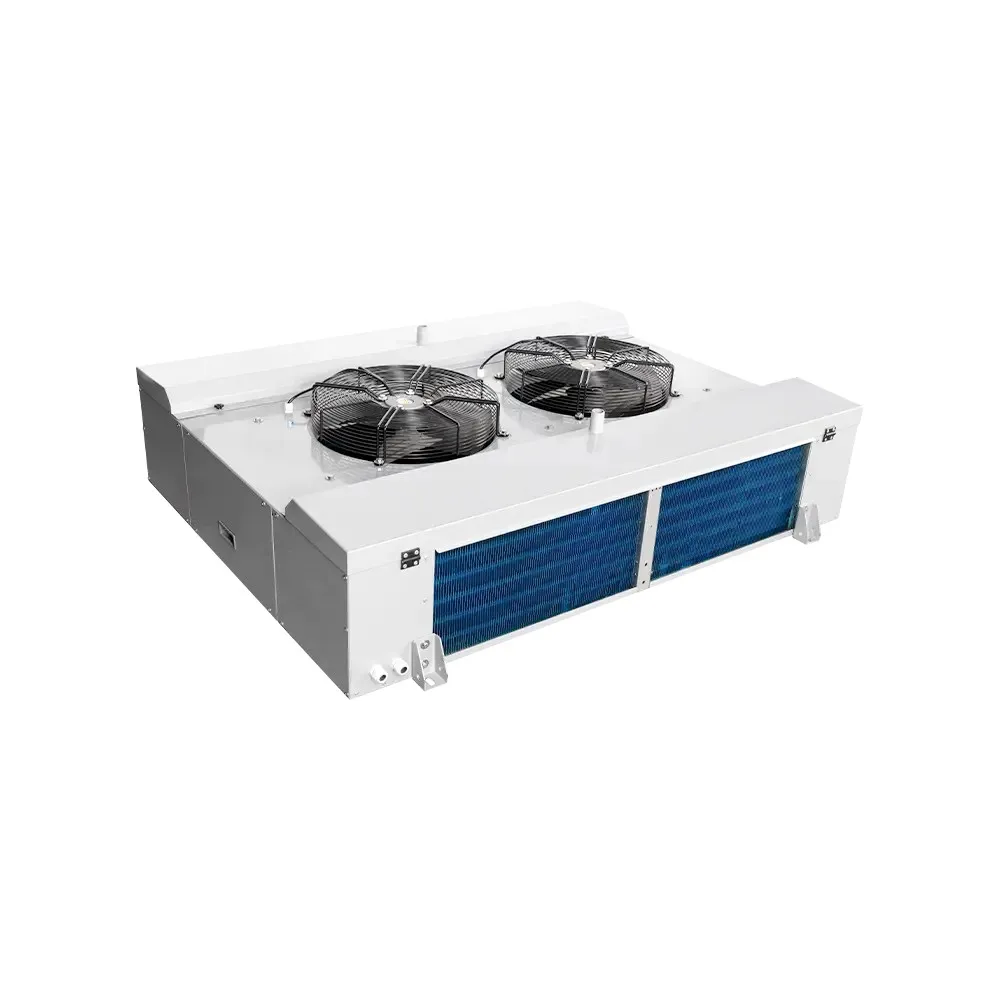
Heat Exchanger Coil
Dual-sided symmetrical copper tube bundle mechanically expanded with blue hydrophilic corrugated aluminum fins, delivering high thermodynamic heat transfer and balanced bilateral evaporation across cold processing halls.
As an important component of a refrigeration system, the evaporator absorbs heat from the surrounding air and transfers it to the circulating refrigerant. When properly matched with the refrigeration system, the ED Series can support temperature control for refrigerated storage and processing applications.
Key Features of the ED Series Industrial Double-Sided Blow Evaporator
Double-Sided Air Discharge Design
The ED Series features a double-sided air discharge configuration designed to distribute cooled air in two directions. This design can help improve airflow coverage in suitable refrigerated spaces, depending on room layout, installation position, and operating conditions.
Efficient Heat Exchange
The evaporator transfers heat from the refrigerated environment to the refrigerant circulating through its heat exchanger. Proper equipment selection helps meet the cooling requirements of the application and supports stable refrigeration performance.
Effective Air Circulation
Air circulation is essential for maintaining appropriate temperature conditions in cold storage environments. The double-sided air discharge design helps distribute cooled air across the designated area when the evaporator is correctly positioned and selected.
Space-Efficient Installation
The ED Series can be considered for refrigeration projects where equipment placement and airflow coverage are important. Its installation arrangement should be planned according to the available space, ceiling height, and refrigerated room layout.
Integration with Refrigeration Systems
The ED Series Industrial Double-Sided Blow Evaporator can be incorporated into a compatible refrigeration system. The selected model must match the refrigerant, cooling capacity requirements, operating conditions, and system configuration.
Maintenance and Service Access
Adequate clearance should be provided for equipment inspection, cleaning, and maintenance. Accessible installation arrangements help simplify routine servicing and support reliable operation.
ED Series Industrial Double-Sided Blow Evaporator Technical Specifications
The technical specifications of the ED Series depend on the selected model and its intended operating conditions. Buyers should refer to the official product catalogue or technical datasheet for verified performance data.
| Standard Fan Speed (1420 rpm) — Fin Spacing 4.0mm | |||||||||||
|---|---|---|---|---|---|---|---|---|---|---|---|
| Model | Cooling capacity / R404A (kW) | Area (m²) | Tube vol. (dm³) | Air volume (m³/h) | Air throw (m) | Interface specifications (mm) | Weight (kg) | ||||
| Tc = 0℃ (ΔT = 8K) | Tc = 10℃ (ΔT = 10K) | Liquid inlet | Suction outlet | Drain | |||||||
| EC351/CLN-ET | 3.2 | 4.7 | 13.1 | 2.5 | 2200 | 6 | φ12 | φ22 | R1" | 31 | |
| EC351/DLN-ET | 4.0 | 5.8 | 17.5 | 3.4 | 2000 | 6 | φ12 | φ22 | R1" | 33 | |
| EC352/CLN-ET | 6.5 | 9.5 | 26.3 | 4.7 | 4400 | 8 | φ12 | φ22 | R1" | 51 | |
| EC352/DLN-ET | 8.0 | 11.7 | 35.0 | 6.3 | 4000 | 8 | φ12 | φ22 | R1" | 55 | |
| EC353/CLN-ET | 9.8 | 14.4 | 39.4 | 6.9 | 6600 | 9 | φ16 | φ28 | R1" | 73 | |
| EC353/DLN-ET | 12.0 | 17.6 | 52.5 | 9.2 | 6000 | 9 | φ16 | φ28 | R1" | 79 | |
| EC354/CLN-ET | 13.1 | 19.2 | 52.5 | 9.1 | 8800 | 10 | φ16 | φ28 | R1" | 93 | |
| EC354/DLN-ET | 16.1 | 23.6 | 70.0 | 12.2 | 8000 | 10 | φ16 | φ35 | R1" | 100 | |
1) Tc is the cold room temperature, and ΔT is the temperature difference between room temperature and evaporating temperature.
2) Air throw is measured at room temperature with residual velocity of 0.5 m/s.
3) For cooling capacities under other operating conditions, refer to the correction factor table.
| Standard Fan Speed (1420 rpm) — Fin Spacing 6.0mm | |||||||||||
|---|---|---|---|---|---|---|---|---|---|---|---|
| Model | Cooling capacity / R404A (kW) | Area (m²) | Tube vol. (dm³) | Air volume (m³/h) | Air throw (m) | Interface specifications (mm) | Weight (kg) | ||||
| Tc = 0℃ (ΔT = 8K) | Tc = -18℃ (ΔT = 7K) | Liquid inlet | Suction outlet | Drain | |||||||
| EC351/CDN-ET | 2.5 | 2.0 | 9.0 | 2.5 | 2350 | 6 | φ12 | φ22 | R1" | 30 | |
| EC351/DDN-ET | 3.1 | 2.4 | 12.0 | 3.4 | 2200 | 6 | φ12 | φ22 | R1" | 32 | |
| EC352/CDN-ET | 5.1 | 4.1 | 18.1 | 4.7 | 4700 | 8 | φ12 | φ22 | R1" | 50 | |
| EC352/DDN-ET | 6.3 | 5.0 | 24.1 | 6.3 | 4400 | 8 | φ12 | φ22 | R1" | 53 | |
| EC353/CDN-ET | 7.6 | 6.0 | 27.1 | 6.9 | 7050 | 9 | φ16 | φ28 | R1" | 71 | |
| EC353/DDN-ET | 9.4 | 7.5 | 36.1 | 9.2 | 6600 | 9 | φ16 | φ28 | R1" | 76 | |
| EC354/CDN-ET | 10.1 | 8.0 | 36.1 | 9.1 | 9400 | 10 | φ16 | φ28 | R1" | 91 | |
| EC354/DDN-ET | 12.5 | 10.0 | 48.2 | 12.2 | 8800 | 10 | φ16 | φ35 | R1" | 97 | |
1) Tc is the cold room temperature, and ΔT is the temperature difference between room temperature and evaporating temperature.
2) Air throw is measured at room temperature with residual velocity of 0.5 m/s.
3) For cooling capacities under other operating conditions, refer to the correction factor table.
| Fan Low Speed (920 rpm) — Fin Spacing 4.0mm | |||||||||||
|---|---|---|---|---|---|---|---|---|---|---|---|
| Model | Cooling capacity / R404A (kW) | Area (m²) | Tube vol. (dm³) | Air volume (m³/h) | Air throw (m) | Interface specifications (mm) | Weight (kg) | ||||
| Tc = 0℃ (ΔT = 8K) | Tc = 10℃ (ΔT = 10K) | Liquid inlet | Suction outlet | Drain | |||||||
| EC351/CLS-ET | 2.4 | 3.2 | 13.1 | 2.5 | 1300 | 5 | φ12 | φ22 | R1" | 31 | |
| EC351/DLS-ET | 2.8 | 3.8 | 17.5 | 3.4 | 1150 | 5 | φ12 | φ22 | R1" | 33 | |
| EC352/CLS-ET | 4.7 | 6.6 | 26.3 | 4.7 | 2600 | 7 | φ12 | φ22 | R1" | 51 | |
| EC352/DLS-ET | 5.6 | 7.7 | 35.0 | 6.3 | 2300 | 7 | φ12 | φ22 | R1" | 55 | |
| EC353/CLS-ET | 7.1 | 9.8 | 39.4 | 6.9 | 3900 | 8 | φ16 | φ28 | R1" | 73 | |
| EC353/DLS-ET | 8.4 | 11.6 | 52.5 | 9.2 | 3450 | 8 | φ16 | φ28 | R1" | 79 | |
| EC354/CLS-ET | 9.5 | 13.0 | 52.5 | 9.1 | 5200 | 9 | φ16 | φ28 | R1" | 93 | |
| EC354/DLS-ET | 11.2 | 15.4 | 70.0 | 12.2 | 4600 | 9 | φ16 | φ35 | R1" | 100 | |
1) Tc is the cold room temperature, and ΔT is the temperature difference between room temperature and evaporating temperature.
2) Air throw is measured at room temperature with residual velocity of 0.5 m/s.
3) For cooling capacities under other operating conditions, refer to the correction factor table.
| Fan Low Speed (920 rpm) — Fin Spacing 6.0mm | |||||||||||
|---|---|---|---|---|---|---|---|---|---|---|---|
| Model | Cooling capacity / R404A (kW) | Area (m²) | Tube vol. (dm³) | Air volume (m³/h) | Air throw (m) | Interface specifications (mm) | Weight (kg) | ||||
| Tc = 0℃ (ΔT = 8K) | Tc = -18℃ (ΔT = 7K) | Liquid inlet | Suction outlet | Drain | |||||||
| EC351/CDS-ET | 2.0 | 1.6 | 9.0 | 2.5 | 1300 | 5 | φ12 | φ22 | R1" | 30 | |
| EC351/DDS-ET | 2.4 | 1.9 | 12.0 | 3.4 | 1450 | 5 | φ12 | φ22 | R1" | 32 | |
| EC352/CDS-ET | 4.2 | 3.3 | 18.1 | 4.7 | 2600 | 7 | φ12 | φ22 | R1" | 50 | |
| EC352/DDS-ET | 5.1 | 4.0 | 24.1 | 6.3 | 2900 | 7 | φ12 | φ22 | R1" | 53 | |
| EC353/CDS-ET | 6.2 | 5.0 | 27.1 | 6.9 | 3900 | 8 | φ16 | φ28 | R1" | 71 | |
| EC353/DDS-ET | 7.6 | 6.0 | 36.1 | 9.2 | 4350 | 8 | φ16 | φ28 | R1" | 76 | |
| EC354/CDS-ET | 8.3 | 6.6 | 36.1 | 9.1 | 5200 | 9 | φ16 | φ28 | R1" | 91 | |
| EC354/DDS-ET | 10.1 | 8.0 | 48.2 | 12.2 | 5800 | 9 | φ16 | φ35 | R1" | 97 | |
1) Tc is the cold room temperature, and ΔT is the temperature difference between room temperature and evaporating temperature.
2) Air throw is measured at room temperature with residual velocity of 0.5 m/s.
3) For cooling capacities under other operating conditions, refer to the correction factor table.
| Electrical Parameters of EC Series (Fan Motor & Electric Defrost) | |||||||
|---|---|---|---|---|---|---|---|
| Model | Fan Motor | Electric Defrost (kW) | |||||
| Voltage (V) | Power (W) | Current (A) | Speed (r/min) | Coil | Water tray | Total power | |
| Standard Fan Speed Series (1420 rpm) | |||||||
| EC351/**N-ET | 380V / 3PH | 165 | 0.43 | 1420 | 2×0.6 | 2×0.6 | 2.4 |
| EC352/**N-ET | 380V / 3PH | 330 | 0.86 | 1420 | 2×1.1 | 2×1.1 | 4.4 |
| EC353/**N-ET | 380V / 3PH | 495 | 1.29 | 1420 | 2×1.6 | 2×1.6 | 6.4 |
| EC354/**N-ET | 380V / 3PH | 660 | 1.72 | 1420 | 2×2.0 | 2×2.0 | 8.0 |
| Low Fan Speed Series (920 rpm) | |||||||
| EC351/**S-ET | 380V / 3PH | 80 | 0.32 | 920 | 2×0.6 | 2×0.6 | 2.4 |
| EC352/**S-ET | 380V / 3PH | 160 | 0.64 | 920 | 2×1.1 | 2×1.1 | 4.4 |
| EC353/**S-ET | 380V / 3PH | 240 | 0.96 | 920 | 2×1.6 | 2×1.6 | 6.4 |
| EC354/**S-ET | 380V / 3PH | 320 | 1.28 | 920 | 2×2.0 | 2×2.0 | 8.0 |
Note: ** represents fin spacing and structure codes (e.g., CL, DL, CD, DD).
ED Series Evaporator Operating Range
The operating range of an industrial evaporator depends on its design, refrigerant, system configuration, and intended application. The actual operating temperatures and performance should be confirmed through official product documentation.
Medium-Temperature Refrigeration Applications
Medium-temperature refrigeration is commonly used for chilled food storage, beverage warehouses, and food processing areas. Effective heat exchange and suitable air circulation help support the required temperature conditions.
The ED Series may be considered for these applications when the selected model meets the project's cooling and operating requirements.
Low-Temperature Refrigeration Applications
Low-temperature refrigeration is used for frozen food storage, meat and seafood preservation, and other applications requiring sub-zero temperatures.
When selecting an evaporator for low-temperature operation, it is important to consider frost formation, defrost requirements, refrigerant compatibility, and airflow performance.
The suitability of a specific ED Series model for low-temperature applications should be confirmed with KAIDELI.
Heat Exchanger, Fan & Refrigeration Component Configuration
The performance of an industrial evaporator depends on the coordination of its heat exchanger, fan assembly, housing, refrigerant connections, and electrical components.
Evaporator Heat Exchanger
The heat exchanger provides the surface required for heat transfer between the refrigerated air and the circulating refrigerant. Its design and capacity influence the overall cooling performance of the evaporator.
Fan Motor and Fan Assembly
The fan assembly circulates air through the heat exchanger and distributes cooled air into the refrigerated space. Fan quantity, airflow, and motor specifications depend on the selected model.
Double-Sided Air Outlet Structure
The double-sided air outlet arrangement directs cooled air toward two sides of the installation area. Proper positioning and sufficient airflow clearance are important for achieving the intended air distribution.
Refrigerant Connections
The refrigerant inlet and outlet connections allow the evaporator to be integrated into a compatible refrigeration system. Connection dimensions and configurations should be verified before installation.
Housing and Mounting Structure
The housing protects and supports the internal components, while the mounting structure secures the unit in its designated position. Installation requirements depend on the equipment dimensions and the conditions of the site.
Electrical and Control Components
Electrical and control components support fan operation and system integration, depending on the product configuration. Buyers should confirm power supply requirements, motor specifications, and control arrangements before installation.
ED Series Industrial Double-Sided Blow Evaporator Models & Selection Guide
Selecting the right ED Series model requires matching the evaporator's performance to the refrigeration load and physical conditions of the application.
Consider the following factors during selection:
Cooling capacity: Determine the refrigeration load based on room dimensions, insulation, product load, and operating conditions.
Room temperature: Identify whether the application requires medium-temperature or low-temperature refrigeration.
Air distribution: Evaluate the room layout, product arrangement, and required airflow coverage.
Refrigerant type: Confirm compatibility with the refrigerant and refrigeration system.
Installation space: Check available installation space, mounting requirements, and service clearance.
Defrost requirements: Consider frost formation and the defrost method required for the application.
Electrical specifications: Verify the available power supply and fan motor requirements.
Operating environment: Consider humidity, corrosion exposure, and other environmental factors.
For model recommendations, provide KAIDELI with the target room temperature, room dimensions, cooling capacity requirements, refrigerant type, and installation details.
ED Series Evaporator Dimensions & Installation Requirements
Correct installation helps support effective airflow, heat exchange, and long-term equipment performance.
Installation Position
The evaporator should be positioned according to the room layout and required airflow distribution. The double-sided air discharge design should be considered when determining the installation location.
Mounting Space and Structural Support
Before installation, confirm the equipment dimensions, mounting arrangement, available space, and load-bearing capacity of the supporting structure.
Airflow Clearance
Keep the air inlet and outlet areas clear of obstructions. Avoid placing products, partitions, or other objects where they may interfere with the intended airflow.
Refrigerant Piping
Refrigerant piping should be designed according to the requirements of the complete refrigeration system. Pipe dimensions, connection types, operating pressures, and refrigerant compatibility must be verified before installation.
Electrical Connections
Electrical work should comply with the selected model's specifications and applicable regulations. Installation should be carried out by qualified personnel.
Maintenance Access
Provide sufficient clearance for inspection, cleaning, and servicing. Regular maintenance helps keep the heat exchanger and fan assembly in suitable operating condition.
Technical Drawings and Dimensions
Exact dimensions, mounting positions, connection sizes, and installation clearances vary by model. Consult the official ED Series technical drawings before preparing the installation layout.
ED Series Industrial Double-Sided Blow Evaporator Applications for Cold Storage & Industrial Refrigeration
The ED Series is designed for consideration in refrigeration projects where double-sided air discharge and suitable cooling performance are required. Actual application suitability depends on the selected model and operating conditions.
Cold Storage & Refrigerated Warehouses
Cold storage facilities require appropriate heat exchange and air circulation to maintain the required storage temperature. The ED Series may be suitable for refrigerated warehouses when its cooling capacity and airflow characteristics match the room requirements.
Food Processing Refrigeration
Food processing facilities often require temperature-controlled areas for ingredients, intermediate products, and finished goods. The evaporator should be selected according to the required temperature, refrigeration load, and operating environment.
Meat & Seafood Cold Storage
Meat and seafood storage requires careful temperature management to support product quality and food safety. Equipment selection should consider the required storage temperature, moisture conditions, refrigeration load, and hygiene requirements.
Cold Chain Logistics
Cold chain facilities depend on reliable refrigeration equipment to support temperature-controlled storage and handling. The ED Series may be considered for suitable refrigerated logistics areas after its operating range and cooling performance have been verified.
Commercial Refrigeration
Commercial refrigeration applications may include chilled storage rooms, food service facilities, and other temperature-controlled environments. The selected evaporator must meet the cooling load and airflow requirements of the specific application.
Industrial Refrigeration Systems
In industrial refrigeration systems, evaporators must be matched with the refrigeration compressor, condensing unit, refrigerant, and system controls. Proper system integration helps achieve the required cooling performance and stable operation.
Double-Sided Blow Evaporator vs Single-Sided Blow Evaporator: Which Is Right for Your Project?
Double-sided and single-sided air discharge evaporators offer different airflow arrangements. The most suitable option depends on the room layout, installation location, product arrangement, and required air distribution.
Double-Sided Blow Evaporator
A double-sided blow evaporator directs cooled air toward two sides. This configuration may be beneficial when the room layout allows airflow to be distributed in both directions.
Single-Sided Blow Evaporator
A single-sided blow evaporator directs air primarily in one direction. It may be suitable for installation arrangements where airflow needs to be concentrated toward a particular area.
How to Choose the Right Evaporator Type
When comparing different evaporator configurations, consider:
Room dimensions and layout
Required cooling capacity
Airflow direction and coverage
Product storage arrangement
Installation position and available space
Refrigerant and system compatibility
Defrost requirements
Maintenance accessibility
The final selection should be based on verified product specifications and the actual refrigeration requirements of the project.
How to Select the Right Evaporator for Your Refrigeration System
Choosing the right evaporator requires evaluating the cooling load, operating temperature, airflow requirements, and refrigeration system configuration.
Calculate the Refrigeration Load
Consider room dimensions, insulation performance, product temperature, incoming product load, door-opening frequency, lighting, personnel, and other sources of heat.
Determine the Required Room Temperature
Define the target storage temperature before selecting the evaporator. The required operating conditions affect the model selection and refrigeration system design.
Confirm Refrigerant Compatibility
The evaporator must be compatible with the refrigerant and operating conditions of the system. Refrigerant type, operating pressure, and system configuration should be checked during selection.
Evaluate Airflow Distribution
Consider how cooled air will move through the room and around stored products. The double-sided air discharge design should match the room layout and the required airflow coverage.
Consider Defrost and Maintenance
Frost accumulation can reduce heat transfer and airflow, particularly in low-temperature applications. Evaluate the required defrost arrangement and maintenance procedures during system planning.
Verify Technical Specifications
Review the cooling capacity, airflow, fan motor specifications, dimensions, refrigerant connections, and installation requirements using the official technical datasheet.
Why Choose KAIDELI as Your Industrial Refrigeration Equipment Manufacturer?
Choosing refrigeration equipment requires consideration of product specifications, application requirements, and compatibility with the overall refrigeration system.
Refrigeration Equipment Solutions
KAIDELI provides refrigeration equipment for commercial and industrial applications. Customers can discuss their project requirements to identify suitable equipment options.
Application-Based Model Selection
Information about room temperature, refrigeration load, refrigerant, airflow requirements, and installation conditions helps determine which evaporator model may be appropriate.
Technical Specification Support
Before purchase and installation, buyers should verify the product's technical datasheet, dimensions, electrical requirements, and connection details. Contact KAIDELI for available technical information about the ED Series.
Support for Commercial and Industrial Projects
Whether the project involves cold storage, refrigerated warehouses, food processing, or other industrial refrigeration applications, equipment selection should be based on the actual cooling requirements and system design.
ED Series Industrial Double-Sided Blow Evaporator FAQs
What Is an ED Series Industrial Double-Sided Blow Evaporator?
The ED Series Industrial Double-Sided Blow Evaporator is an evaporator designed with a double-sided air discharge arrangement. It transfers heat from the refrigerated environment to the circulating refrigerant while distributing cooled air toward two sides.
What Are the Main Applications of the ED Series?
Potential applications include cold storage rooms, refrigerated warehouses, food processing facilities, and other commercial or industrial refrigeration environments, provided the selected model meets the required operating conditions.
What Are the Main Components of the ED Series Evaporator?
Typical evaporator components may include a heat exchanger, fan motor, fan assembly, housing, refrigerant connections, mounting structure, and electrical components. The exact configuration depends on the specific model.
Can the ED Series Be Used for Low-Temperature Refrigeration?
Suitability for low-temperature applications depends on the model's design, cooling performance, refrigerant, and operating conditions. Confirm the applicable temperature range and technical specifications with KAIDELI before selection.
What Is the Advantage of a Double-Sided Blow Evaporator?
A double-sided blow evaporator directs cooled air toward two sides, which may help distribute air across suitable refrigerated spaces. Actual airflow performance depends on the equipment model, installation position, room layout, and operating conditions.
How Do I Choose the Right ED Series Model?
Model selection depends on cooling capacity, room temperature, refrigerant type, airflow requirements, installation space, and defrost requirements. Providing these details helps support accurate equipment selection.
How Can I Obtain ED Series Technical Specifications?
Contact KAIDELI to request available product datasheets, model dimensions, cooling performance information, and other technical specifications for your refrigeration project.
Keep in touch with us
Looking for the right refrigeration equipment for your cold storage project? Contact our team for product information, technical support, and a suitable refrigeration solution for your application.
Mob:+86-159 6116 8909
E-mail::aaron@freezercold.com


